Water problems in a North Texas yard can look similar at first. You see a puddle beside the patio, a muddy strip through the lawn, water rushing across the driveway, or soil washing away after a storm.
The solution, however, should depend on how the water is moving.
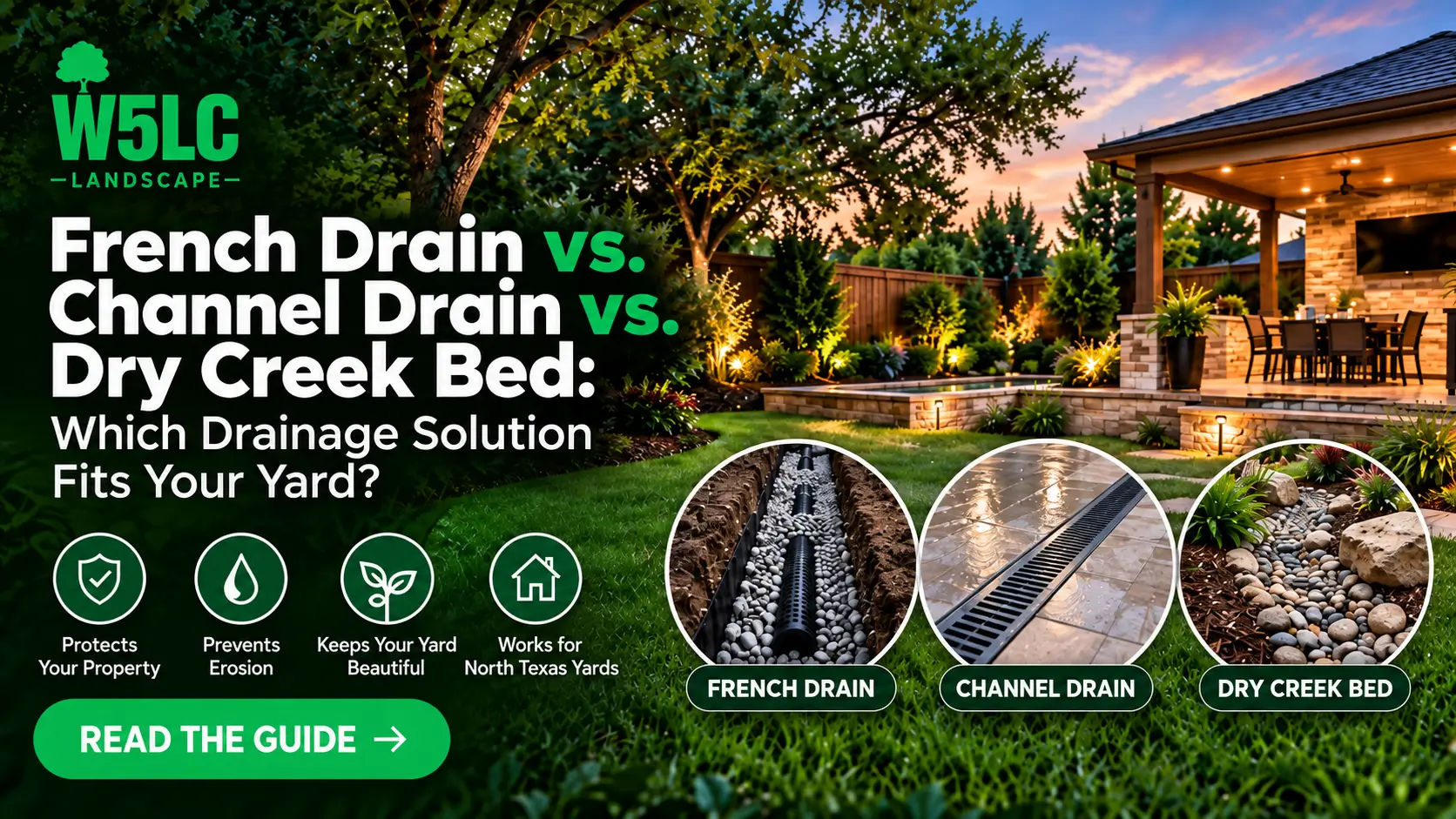
That is why comparing french drain vs channel drain systems is more useful than simply choosing the drainage product you have heard about most. A French drain is designed mainly to collect excess water within saturated soil. A channel drain captures surface water moving across a hard area. A dry creek bed creates a visible route that can guide and slow surface runoff while becoming part of the landscape.
For homeowners in Southlake, Colleyville, Keller, Richardson, Highland Village, and nearby DFW communities, W5LC Landscape evaluates the property before recommending a drainage approach.
The best drainage solution for yard problems is the one that addresses where the water starts, how it travels, and where it can safely go.
Before comparing drainage systems, watch what happens during rainfall.
Do not focus only on the place where water finally collects.
If an area stays wet long after a storm, feels soft underfoot, or repeatedly develops shallow standing water, the issue may involve slow-draining soil or subsurface moisture.
This is the type of condition where a French drain may help.
Hard surfaces cannot absorb rainfall.
When runoff moves quickly across a driveway, patio, pool deck, or walkway, you need a system capable of intercepting surface water before it reaches a garage, foundation, lawn, or low area.
A channel drain is often better suited to this type of problem.
Some yards naturally receive runoff along a low swale or sloped section.
When water follows an obvious surface route, a dry creek bed may provide a more attractive way to carry that flow across the landscape.
The first step is not asking which system is best overall. It is identifying which system matches the behavior of the water.
A French drain is a subsurface drainage system typically built with perforated pipe surrounded by free-draining stone within a trench.
Water enters through the surrounding material and openings in the pipe, then moves toward an appropriate outlet.
W5LC Landscape provides French drain systems for North Texas yards where standing water, soil saturation, foundation drainage, downspout runoff, or erosion needs to be addressed.
A French drain may be useful for:
The system is mostly hidden after installation, which makes it attractive when homeowners want drainage without a highly visible feature.
A French drain should not automatically be used for every surface runoff problem.
If a large amount of water is rushing across a concrete driveway during a thunderstorm, asking that water to first soak through soil or gravel before entering a perforated pipe may not be the most direct approach.
That is where the french drain vs channel drain comparison becomes important.
A channel drain, sometimes called a trench drain depending on the product and application, is a long, narrow surface drainage system covered by a grate.
Water flows directly into the opening and is carried through a connected drainage line.
Channel drains are often used across or beside:
W5LC Landscape discusses trench drains as an option for drainage on sloped driveways, particularly when runoff needs to be intercepted before it reaches a garage or lower part of the property.
The main advantage is immediate surface collection.
Instead of waiting for water to infiltrate into soil, the open grate receives runoff as it crosses the hard surface.
Installing a channel drain in the wrong location limits its effectiveness.
The surrounding surface must direct water toward the drain, and the connected pipe still needs an appropriate route and outlet.
A drainage system is only as useful as the path it creates from collection point to discharge point.
The simplest distinction is where the system collects water.
A French drain collects water from within or immediately around saturated ground.
A channel drain collects water directly from the surface.
Think of it this way:
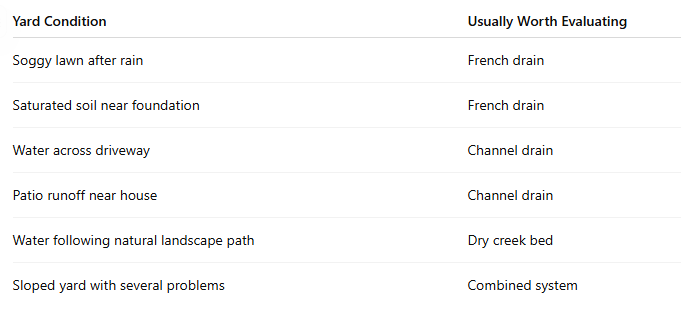
These are general examples, not automatic prescriptions. Grading, discharge location, soil, elevations, neighboring runoff, and existing drainage can change what the property needs.
A dry creek bed is a shallow landscape channel constructed with stone, gravel, boulders, and sometimes plants.
Most of the time it remains dry. During rainfall, it gives surface runoff a defined route through the yard.
Unlike buried drainage, the system becomes part of the visible landscape.
A well-designed creek bed can:
Natural stone can make the feature feel intentional instead of looking like a utility trench.
W5LC Landscape also works with natural boulders and integrated landscape features, which can complement a drainage-focused landscape design.
The dry creek bed vs french drain decision often comes down to surface runoff versus saturated soil.
Choose this direction when the primary issue is water lingering within the soil.
The finished system can remain relatively hidden beneath gravel, turf, or landscaping depending on its design.
A creek bed is more appropriate when water naturally moves across the top of the property and you want to control that route.
It can be especially useful where runoff from a higher elevation travels toward a lower section of the yard.
A property may have runoff traveling down a slope and a low area that becomes saturated afterward.
In that case, a dry creek bed could manage visible surface flow while another drainage method addresses the wet area.
The best design follows the actual water pattern rather than limiting the project to one type of drain.
Understanding other types of yard drainage systems helps homeowners see why drainage is rarely one-size-fits-all.
A catch basin collects water at a specific low point through a grated opening.
It can work well where runoff consistently gathers in one defined location.
The basin connects to solid drainage pipe that carries the collected water elsewhere.
Roof runoff can create surprisingly large water problems.
Downspout extensions or underground piping move concentrated roof water away from sensitive sections of the landscape.
A swale is a broad, shallow depression shaped into the grade to move or manage surface runoff.
Unlike a pipe, it uses the landscape itself as part of the drainage system.
French drains address water moving within saturated soil and can help dry problem areas.
These systems intercept surface water across hardscape where rapid collection is needed.
Dry creek beds create a stone-lined path for surface runoff while adding a natural-looking landscape feature.
A retaining wall changes the grade and holds soil in place, but water behind the wall still needs somewhere to go.
W5LC Landscape's retaining wall services consider slope, soil, drainage, and erosion as part of wall planning.
The best drainage solution for yard problems is usually determined through diagnosis.
Start with five questions.
Look uphill from the wet area.
The source could be:
Visible flowing water points toward surface management.
Persistent saturated ground suggests that subsurface drainage may also be needed.
Fast-moving runoff can cause erosion and may need a system that captures or slows water quickly.
Every drainage solution needs a destination.
Collecting water without a practical discharge route only moves the problem into a pipe.
Drainage should work with the landscape.
A visible dry creek may enhance one property, while another homeowner may prefer a more concealed system.
Professional landscape design services can integrate drainage with patios, turf, planting, walls, and outdoor living features.
Patios create runoff because they replace absorbent ground with hardscape.
The first requirement is proper grading so water moves away from the home.
If water moves toward a doorway, wall, or low edge of the patio, a channel drain may capture it before it reaches the problem area.
If soil beside the patio remains soggy, a French drain may be considered depending on the site's elevations and outlet options.
W5LC Landscape recommends addressing drainage as part of professional paver patio planning, rather than waiting until the finished patio creates or exposes a water problem.
Slopes make drainage more complicated because gravity increases the speed of runoff.
Water may erode soil at the top of the slope, travel through planting beds, and collect at the bottom.
A sloped yard might need:
The system should manage water from the highest problem area to the final outlet.
Drainage is not only about removing water as quickly as possible.
Uncontrolled discharge can create erosion, damage landscaping, or move excess water into another problem area.
The design should control both direction and flow.
Many drainage problems become more expensive because an initial repair treated the puddle rather than the cause.
French drains are useful, but they are not universal.
Fast surface water across concrete may require a different collection method.
Adding soil raises the low spot, but the water still needs somewhere to travel.
The new grade may simply move the puddle closer to the house or another part of the yard.
A drainage improvement should not create a new runoff problem on an adjoining property.
Fixing lawn drainage without managing roof runoff can leave a major water source unchanged.
A new patio, walkway, wall, or turf area can change runoff patterns.
Drainage should be considered before permanent outdoor improvements are installed.
W5LC Landscape starts with the property rather than assuming a particular drainage product is needed.
A useful site evaluation considers:
That information helps determine whether the property needs a French drain, surface collection system, grading correction, retaining feature, or several solutions working together.
Homeowners can explore completed W5LC Landscape projects and read local customer feedback through the W5LC Landscape Google Business Profile.
A French drain collects excess water through gravel and perforated pipe below or within the ground. A channel drain uses a surface grate to capture water flowing across hardscape such as patios or driveways.
Neither is universally better. French drains are generally better suited to saturated soil and certain subsurface drainage problems. Channel drains are designed to quickly capture surface runoff crossing paved areas. The water problem should determine the system.
The best solution depends on whether the problem comes from poor grading, roof runoff, saturated soil, surface flow, hardscape, or a combination of factors. Some yards require several drainage methods working together.
A dry creek bed is a visible, stone-lined surface route that guides runoff through the landscape. A French drain is primarily a subsurface system that collects excess water from saturated ground.
Sometimes, but only when the issue is mainly surface runoff. A dry creek bed will not necessarily correct deep or persistent soil saturation. The source and movement of the water should be evaluated first.
Yes. Channel or trench drains are commonly used where water travels across a driveway, especially near garage entrances or lower elevations. Proper placement, slope, pipe sizing, and discharge are still important.
Yes. Complex properties often perform better with a combination of grading, downspout routing, French drains, catch basins, channel drains, dry creek beds, or retaining-wall drainage.
Signs may include persistent soggy ground, recurring standing water, saturated areas beside structures, or water moving through soil on a slope. A site evaluation can determine whether a French drain is appropriate or whether another drainage method would work better.
Not necessarily. If water is rapidly flowing across the patio surface, a channel drain or grading correction may be more appropriate. French drains generally address water entering through surrounding soil rather than immediately capturing large amounts of surface runoff.
W5LC Landscape provides French drain systems and broader landscape solutions for homeowners throughout the DFW Metroplex. Drainage can also be coordinated with grading, retaining walls, patios, and landscape design.
When homeowners compare french drain vs channel drain systems, the most important question is not which product is more popular. It is how water behaves on the property.
Saturated soil may point toward a French drain. Fast runoff across a driveway or patio may need a channel drain. A visible flow path through a landscaped slope may work well as a dry creek bed.
Some properties need all three ideas working in different areas.
The goal is to collect water in the right place, move it through an appropriate route, protect the landscape from erosion, and discharge it without creating another problem.
W5LC Landscape works with homeowners in Southlake, Colleyville, Keller, Richardson, Highland Village, and surrounding North Texas communities to develop drainage and landscape solutions around actual site conditions.
Still unsure which system fits your yard? Review W5LC's frequently asked landscaping questions, or contact W5LC Landscape for a free on-site estimate to have the property evaluated before the next heavy North Texas storm exposes the problem again.


