
Standing water in the lawn, muddy side yards, erosion, and water collecting near a foundation usually lead homeowners to the same question: how much will it cost to fix the drainage problem correctly?
The drainage installation cost in Texas varies widely because drainage is not one standard product. One property may only need a short drain line and improved downspout routing. Another may require excavation across the yard, several catch basins, grading changes, a French drain, and landscape restoration.
For 2026 planning, national project data places many professional yard drainage systems between about $2,145 and $7,173, with simpler projects sometimes costing less and complex drainage work reaching $15,000 or more. Many systems fall within roughly $10 to $50 per linear foot, although specialized French drains and difficult installations can exceed that range.
Those figures are budgeting references, not W5LC Landscape quotes.
W5LC Landscape evaluates the actual source of the water problem before developing a drainage plan for homes in Southlake, Colleyville, Keller, Richardson, Highland Village, and surrounding DFW communities.
For homeowners asking how much does a drainage system cost, the most useful answer begins with the type of problem being corrected.
A small drainage improvement may cost considerably less than a whole-yard system. The price increases as trench length, excavation depth, materials, grading, disposal, and surface restoration increase.
A general 2026 planning breakdown may look like this:
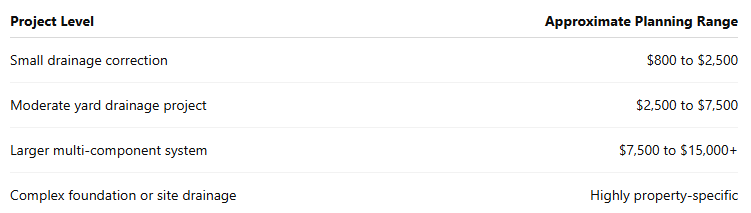
Current cost data places the national average for yard drainage around $4,634, but a Texas homeowner should not treat that number as a quote because soil, access, property size, discharge options, and system type can dramatically change the final price.
Two yards with the same puddle size may require completely different repairs.
One might need a surface drain connected to a short solid pipe. Another might have saturated clay soil requiring a longer French drain with extensive excavation.
That is why the cost to install drainage systems in yard areas should be based on diagnosis first and linear footage second.
Several parts of the project influence drainage system installation cost.
Different systems solve different water problems.
Possible solutions include:
A short downspout extension may be relatively inexpensive. A French drain crossing a large property requires far more excavation, pipe, stone, labor, and restoration.
Longer systems naturally require more materials and labor.
However, linear footage alone does not determine the price. Fifty feet of trench in an open lawn can be much easier to install than fifty feet beside a pool, fence, mature landscaping, utility lines, or hardscape.
Deeper drainage systems require more digging and more material.
The appropriate depth depends on the purpose of the system, existing elevations, soil conditions, and where the water needs to discharge.
Equipment access can make a major difference.
A wide side gate and open yard may allow machinery to handle excavation efficiently. A narrow side yard may require more hand labor.
Difficult access may increase the time required for:
This is one reason accurate drainage pricing usually requires an on-site evaluation.
French drains are one of the most common solutions homeowners research when they have recurring standing water.
A French drain typically uses a sloped trench, perforated pipe, gravel or drainage stone, and protective fabric to intercept and redirect unwanted water.
Current 2026 cost references place many yard French drains around $20 to $50 per linear foot, while the broader national range can extend from roughly $10 to $100 per linear foot when simple yard drains and complex foundation-related installations are considered together.
For a straightforward residential yard project, examples might look like this:
These examples are only simple mathematical planning estimates.
The actual cost to install french drain systems can rise when excavation is difficult, the trench is deeper, extensive landscaping must be restored, multiple drainage lines are connected, or the system requires more complicated discharge planning.
Homeowners may see dramatically different online answers to “how much does it cost to install a french drain?”
The reason is that the term French drain can describe very different projects.
A shallow yard drain addressing a soggy lawn is not comparable to an extensive drainage system installed near structural areas.
W5LC Landscape's professional French drain installation service includes property evaluation, layout planning, excavation, perforated piping, gravel, protective fabric, backfilling, restoration, and final water-flow testing.
A professional yard drainage system price should reflect more than pipe.
Homeowners should understand what is actually included in an estimate.
Before digging begins, the contractor needs to identify:
This step prevents money from being spent on a system that treats the puddle but not the source.
Installation may involve trenching, gravel, perforated pipe, solid drainage pipe, catch basins, fittings, filter fabric, connectors, and outlet components.
The exact materials depend on the system.
Digging through an established lawn or landscape creates restoration work.
After installation, areas may need:
W5LC includes surface restoration as part of its documented French drain installation process.
Yes.
Sometimes the problem is not only underground water. The existing ground may direct rainfall toward a low area or foundation.
In that situation, drainage pipe without grading work may not fully solve the problem.
Regrading changes the elevation of part of the yard so runoff follows a more appropriate path.
It may involve:
For properties undergoing larger improvements, W5LC Landscape can combine drainage planning with professional landscape design.
This allows grading, patios, planting, turf, and water management to be planned as one system.
North Texas soil conditions can affect both drainage problems and installation difficulty.
Clay-rich soil can become hard when dry and heavy when wet. Once saturated, it may absorb rainfall slowly, contributing to surface pooling and runoff.
Clay does not automatically make every drainage project expensive, but soil conditions can influence excavation, system layout, and the amount of restoration required.
Long-term drainage problems may also create:
Those issues may need repair after the drainage system itself is installed.
Sloped properties sometimes need more than drainage pipe.
If soil is eroding or the grade needs to be stabilized, a retaining wall may become part of the larger project.
W5LC Landscape's retaining wall installation service includes evaluation of slope, soil, drainage, excavation, base preparation, and drainage behind the finished wall.
A retaining wall changes how soil and water behave on a property.
Water collecting behind the wall can create pressure, which is why drainage should be incorporated into the design rather than added as an afterthought.
A combined wall and drainage project will naturally cost more than a basic yard drain because it includes structural landscape work.
It can.
Patios, driveways, walkways, and pool decks create hard surfaces that shed rainfall rather than absorbing it.
If runoff from an existing patio is causing the problem, a drainage solution may need to intercept that water.
If a new patio is being planned, drainage should be addressed before construction.
W5LC Landscape's paver patio installation service considers grading and base preparation as part of the project so the patio can work with the surrounding property.
Planning both improvements together may help avoid tearing up finished landscaping later.
The goal should not be finding the cheapest drain. It should be solving the problem with the least unnecessary work.
If one downspout causes most of the problem, correcting that source may cost less than installing an oversized system across the entire yard.
If you already intend to renovate the lawn, patio, or planting beds, coordinate drainage before those improvements.
That prevents finished areas from being disturbed later.
Two drainage quotes may look very different because they include different work.
Ask whether the estimate includes:
A low initial price may not be cheaper if restoration or necessary drainage components are excluded.
Minor water problems can sometimes be addressed with simple landscape corrections.
Professional evaluation becomes more valuable when:
W5LC Landscape evaluates pooling areas and water-flow patterns before developing a custom system, rather than assuming every wet yard requires the same drain.
Homeowners researching the company can also view customer feedback through the W5LC Landscape Google Business Profile.
Many professional yard drainage projects fall between roughly $2,000 and $7,000, although simple corrections can cost less and complex systems may exceed $15,000. Property size, system type, excavation, grading, and restoration determine the final price.
Current 2026 national cost data places many yard French drains around $20 to $50 per linear foot, although total French drain pricing has a much wider range based on location, depth, complexity, and whether foundation-related work is involved.
Using a general planning range of $20 to $50 per linear foot, a 100-foot yard French drain could roughly fall around $2,000 to $5,000. Difficult excavation, restoration, deeper trenches, or complex discharge requirements can increase the total.
Online numbers cannot see your yard. Access, soil, slope, excavation depth, existing landscaping, utilities, disposal, drainage outlets, and restoration all affect labor and materials.
Not always. Some contractors include surface restoration while others price it separately. W5LC Landscape's published French drain process includes restoration with soil, sod, or appropriate landscaping elements after installation.
No. A property may only need downspout routing, grading, a surface drain, or another simpler correction. Installing a French drain where it is not needed can add unnecessary cost.
Sometimes. If several problem areas share the same cause and can connect to an appropriate drainage route, one coordinated system may address them. Other properties require multiple collection points or different types of drainage.
Yes. W5LC Landscape offers drainage evaluations and free on-site consultations for homeowners in Southlake and surrounding DFW communities. The team evaluates water movement before designing the system.
Online pricing can help establish a budget, but it cannot tell you which drainage system your property actually needs.
The most important factor behind drainage installation cost in Texas is not simply the length of pipe. It is the combination of the water source, slope, soil, excavation, system design, access, drainage outlet, and restoration required to correct the problem.
A properly planned system may involve a French drain, surface drainage, downspout routing, grading, retaining-wall drainage, or several solutions working together.
W5LC Landscape provides drainage and landscape services for homeowners throughout Southlake, Colleyville, Keller, Richardson, Highland Village, and nearby DFW communities.
If standing water, runoff, or erosion keeps returning after North Texas storms, contact W5LC Landscape for a free on-site drainage estimate. A property-specific evaluation can give you a much more useful yard drainage system price than a generic online calculator.


